'%3e%3cpath%20id='Path_8'%20data-name='Path%208'%20d='M43.014-47.522H54.352V1.339H43.014V-3.778q-6.973,6.522-15,6.522A21.61,21.61,0,0,1,11.259-4.58Q4.687-12.055,4.688-23.242q0-10.986,6.572-18.311a21.184,21.184,0,0,1,16.455-7.324q8.528,0,15.3,7.023ZM16.226-23.242q0,7.023,3.762,11.438A12.323,12.323,0,0,0,29.72-7.339a12.953,12.953,0,0,0,10.134-4.314,16.707,16.707,0,0,0,3.863-11.338,16.707,16.707,0,0,0-3.863-11.338,12.772,12.772,0,0,0-10.033-4.364,12.478,12.478,0,0,0-9.732,4.415A16.274,16.274,0,0,0,16.226-23.242Z'%20transform='translate(1267.34%20818.803)'/%3e%3cpath%20id='Path_9'%20data-name='Path%209'%20d='M65.234-67.14a6.992,6.992,0,0,1,2.157-5.117,7.049,7.049,0,0,1,5.167-2.157,7.107,7.107,0,0,1,5.217,2.157,6.943,6.943,0,0,1,2.157,5.167,7.107,7.107,0,0,1-2.157,5.217,6.943,6.943,0,0,1-5.167,2.157,7.107,7.107,0,0,1-5.217-2.157A7.166,7.166,0,0,1,65.234-67.14Z'%20transform='translate(1262.665%20881.136)'%20fill='%234973ed'/%3e%3c/g%3e%3c/svg%3e)
'%3e%3cpath%20id='Path_3'%20data-name='Path%203'%20d='M41.992-47.559H53.027V0H41.992V-4.98q-6.787,6.348-14.6,6.348A21.034,21.034,0,0,1,11.084-5.762q-6.4-7.275-6.4-18.164,0-10.693,6.4-17.822A20.619,20.619,0,0,1,27.1-48.877q8.3,0,14.893,6.836ZM15.918-23.926q0,6.836,3.662,11.133a12,12,0,0,0,9.473,4.346,12.608,12.608,0,0,0,9.863-4.2,16.262,16.262,0,0,0,3.76-11.035,16.262,16.262,0,0,0-3.76-11.035,12.431,12.431,0,0,0-9.766-4.248,12.145,12.145,0,0,0-9.473,4.3A15.84,15.84,0,0,0,15.918-23.926ZM77.881-47.559V0H66.895V-47.559Zm19.824,0,12.3,26.709,12.256-26.709h12.354L109.912,3.271,85.4-47.559Zm40.186,23.438a23.632,23.632,0,0,1,7.373-17.529,24.706,24.706,0,0,1,17.969-7.227A24.842,24.842,0,0,1,181.3-41.6a24.212,24.212,0,0,1,7.324,17.871,24.086,24.086,0,0,1-7.373,17.92,25.2,25.2,0,0,1-18.213,7.178,24.167,24.167,0,0,1-17.92-7.324A24.632,24.632,0,0,1,137.891-24.121Zm11.23.2q0,7.129,3.809,11.279a13.409,13.409,0,0,0,10.3,4.2,13.392,13.392,0,0,0,10.3-4.15q3.857-4.15,3.857-11.084t-3.857-11.084a13.409,13.409,0,0,0-10.3-4.2,13.292,13.292,0,0,0-10.205,4.2A15.281,15.281,0,0,0,149.121-23.926Zm51.123-23.633H211.23v4.248a20.979,20.979,0,0,1,5.371-4.346,12.318,12.318,0,0,1,5.664-1.221,17.744,17.744,0,0,1,9.082,2.832l-5.029,10.059a10.489,10.489,0,0,0-6.1-2.246q-8.984,0-8.984,13.574V0H200.244Z'%20transform='translate(1267.34%20738.803)'%20fill='%230D0D0D'/%3e%3cpath%20id='Path_7'%20data-name='Path%207'%20d='M65.234-67.334a6.805,6.805,0,0,1,2.1-4.98,6.861,6.861,0,0,1,5.029-2.1,6.918,6.918,0,0,1,5.078,2.1,6.758,6.758,0,0,1,2.1,5.029,6.918,6.918,0,0,1-2.1,5.078,6.758,6.758,0,0,1-5.029,2.1,6.918,6.918,0,0,1-5.078-2.1A6.975,6.975,0,0,1,65.234-67.334Z'%20transform='translate(1433.453%20799.182)'%20fill='%23FF5C1A'/%3e%3c/g%3e%3c/svg%3e)
The Hidden Work Behind Great Client Service
Selvam Swaminathan, Founder·September 21, 2026
I have been spending a lot of time thinking about how AI can actually help financial advisors and wealth management professionals. Not from the perspective of replacing what they do, but from a very simple question: Where do advisors actually spend their time?
I came across research from Kitces that gave me a very interesting perspective. According to Kitces Research, the typical financial advisor spends only around 20% of their time in actual client meetings. A significantly larger portion of their time is spent on meeting preparation, financial planning analysis, client servicing, follow-up, investment-related work, and administrative activities.
That made me think.
The client meeting is probably not where the biggest opportunity for AI is.
The bigger opportunity is everything that happens around the meeting.
Before a client meeting, an advisor may need to gather information from multiple systems, review the client's portfolio, look at performance, check allocations, identify changes, review previous conversations, understand outstanding requests, and prepare for the discussion.
During the meeting, the advisor does what they do best — they use their experience and judgment to understand the client, discuss their situation, and make decisions.
But then the work starts again.
After the meeting, there may be follow-up questions, additional analysis, CRM updates, documents to prepare, tasks to assign, emails to send, and actions that need to be tracked.
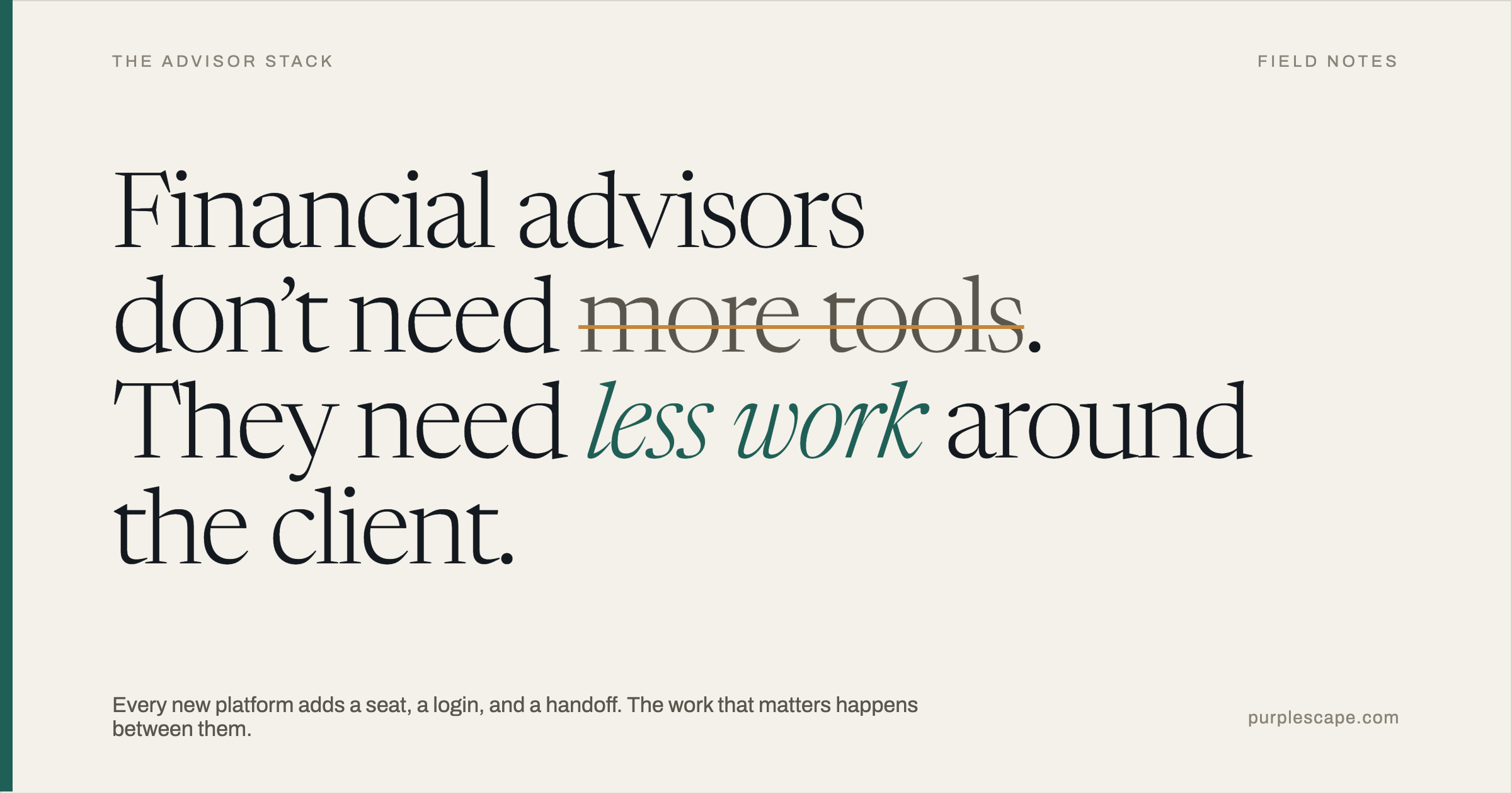
This is a significant amount of work that happens around the client relationship.
And I believe this is where AI can become extremely useful.
Instead of thinking about AI as something that should replace the advisor, I think about it as something that can work alongside the advisor.
For example, AI could help an advisor:
- Prepare for a client meeting by bringing together the relevant information.
- Analyze a client's portfolio and highlight important changes.
- Identify concentration, allocation, performance, or other areas that may require attention.
- Review outstanding client requests and follow-ups.
- Prepare a first draft of a client report.
- Analyze information across the systems the firm already uses.
- Turn a simple request from an advisor into a completed piece of work for the advisor to review.
The important part is that the advisor remains in control.
AI does the preparation, analysis, and repetitive work. The financial professional reviews the output, applies their experience and judgment, and decides what to do.
This also changes how I think about the user experience for AI in wealth management.
I don't think an advisor should have to think about which AI agent or specialist they need to use.
They shouldn't have to ask:
"Which AI should I use for this?"
They should simply be able to say:
"Prepare me for tomorrow's client meeting."
Or:
"Review this client's portfolio and tell me what needs my attention."
Or:
"Prepare the follow-up work from this meeting."
The technology should figure out what needs to happen behind the scenes.
This is a big part of why I'm building Aivor.
The idea is simple: connect Aivor to the systems and data that financial professionals already use, and let it help with the repetitive work involved in preparing, analyzing, reviewing, and following up.
The goal isn't to replace the advisor.
The goal isn't to automate the relationship.
And the goal isn't to give advisors another complicated tool to learn.
The goal is to help financial professionals get the work done faster.
If advisors spend only about one-fifth of their time in actual client meetings, then there is a huge amount of work happening before and after those meetings.
I think that is where AI has an opportunity to make a real difference.
Less time preparing the work. More time acting on it.
That's the direction we're taking with Aivor.
Source: Kitces Research — research on financial advisor productivity and how advisors spend their time.
Have a thought on this post?
Send us a note — we read every one. We don't publish public comments here, so this goes straight to our inbox, not a public thread.